

If you audit the marketing budgets of the top-performing law firms, enterprise private equity funds, and luxury real estate brokerages today, you will find a common denominator: They all own a podcast.
But if you look closer, you will notice an even deeper trend.
The top 1% of these shows do not treat their podcast like a casual hobby or an old-school radio show. They don’t simply record an audio file, upload it to a basic distribution feed, and hope for the best.
Instead, they treat their podcast as the single highest-leverage data, authority, and traffic generator their company owns. They understand a fundamental truth that the other 90% of podcasters completely miss: An audio file sitting on Apple or Spotify is not a business strategy. It is just noise.
To turn a corporate podcast into an elite client-acquisition machine, you have to look past the microphone. You have to look at the digital plumbing.
The Illusion of the “Audio-Only” Strategy
Most traditional media studios will tell you that success is all about downloads. They promise that if you interview interesting guests and edit the audio cleanly, clients will naturally flood your pipeline.
This is an expensive lie.
According to data from Edison Research, the executive audience is highly active—74% of corporate executives and business owners listen to podcasts weekly. However, for high-value professional services, standard consumer downloads are a vanity metric. If you run a commercial real estate firm or a high-ticket legal practice, you don’t need 10,000 anonymous listeners streaming your show while they jog. You need 50 specific managing partners, developers, or corporate executives inside your geographic market to view you as the definitive authority in your space.
When you rely solely on standard audio distribution, three critical vulnerabilities compromise your business ROI:
- The Invisible Audience: Your listeners remain entirely anonymous. You have no names, no corporate emails, and no firmographic data to hand over to your business development team.
- The Search Void: Google’s web crawlers cannot easily read or index raw audio waves. HubSpot’s State of Marketing reports consistently show that SEO drives 1000%+ more traffic than organic social media. Without a text-driven framework, your deep-cut industry insights are completely invisible to search engines.
- The AI Blindspot: Next-generation conversational search tools do not browse audio feeds. Gartner predicts that by 2026, traditional search engine volume will drop by 25% as buyers shift toward AI conversational assistants. If your content is not structurally formatted for the web, your brand will be entirely left out of the equation when a prospective client asks an AI model for an expert recommendation.
To bypass these limitations, elite brands deploy what we call The Authority Infrastructure.
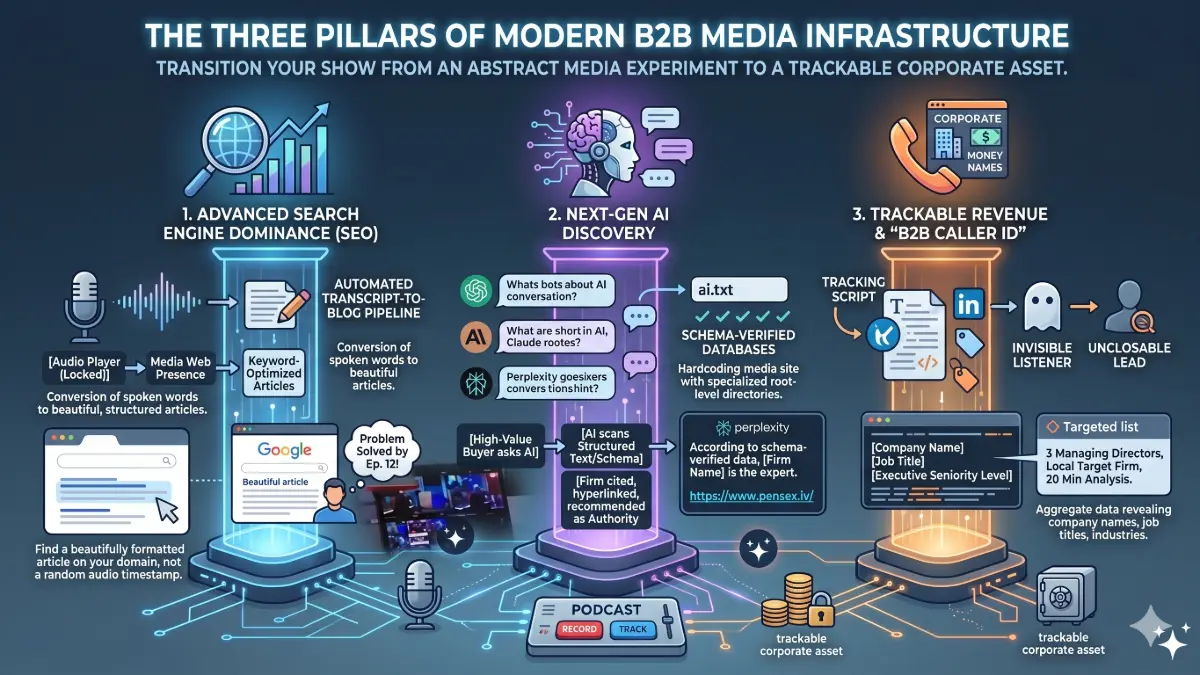
The Three Pillars of Modern B2B Media Infrastructure
To transition your show from an abstract media experiment to a trackable corporate asset, your digital architecture must be engineered across three distinct pillars.
1. Advanced Search Engine Dominance (SEO)
Every single episode you record is a goldmine of proprietary data and industry insights. Sitting in an audio player, that value is locked away.
An enterprise infrastructure automatically unifies your audio with a dedicated, high-speed media web presence. By passing your recordings through an automated transcript-to-blog pipeline, your spoken words are instantly converted into beautifully structured, keyword-optimized articles.
When a prospective client searches Google for a complex industry problem you solved on episode 12, they don’t find a random audio timestamp—they find a beautifully formatted article on your domain, positioning you as the immediate solution to their problem.
2. Next-Gen AI Discovery
The search landscape is shifting under our feet. High-value buyers are increasingly skipping standard search engines entirely, opting to ask tools like ChatGPT, Claude, and Perplexity for direct business advice.
If a real estate developer asks Perplexity, “Who is the top structural mitigation expert for commercial builds in South Florida?” the AI does not guess. It scans the internet for highly structured, machine-readable text files (ai.txt) and schema-verified databases.
By hardcoding your media site with specialized root-level directories, your proprietary corporate insights are served directly to these LLMs. This ensures your firm is actively cited, hyperlinked, and recommended as the trusted authority by conversational search engines.
3. Trackable Revenue & “B2B Caller ID”
An invisible listener is an unclosable lead. High-end media operations strip the guesswork out of marketing spend by injecting specialized tracking scripts—such as the LinkedIn Insight Tag—directly into their media hub.
This infrastructure acts like a corporate Caller ID. Even if an executive listens to your latest episode and leaves your site without filling out a contact form, the backend system generates anonymous, aggregate data revealing the exact company names, job titles, industries, and executive seniority levels of the people consuming your show.
Your marketing team no longer looks at an abstract chart of “100 downloads.” Instead, they receive a targeted list showing them that three managing directors from a specific local target firm spent 20 minutes analyzing your content.
Turning Media Exposure Into Permanent Corporate Equity
Once the data tracking and search visibility are locked in, the final piece of the puzzle is conversion. Data from the Content Marketing Institute shows that 79% of B2B marketers use email newsletters as their primary channel for nurturing audience leads. By pairing your episodes with automated social-to-email lead funnels, casual listeners are seamlessly converted into permanent entries in your corporate database. Whether you utilize targeted comment-to-DM automation (such as instructing listeners to comment a specific keyword to receive an executive checklist) or deploy premium subscriber landing pages, the goal remains identical: transforming abstract attention into measurable business equity.
The era of starting a podcast just to “have a show” is officially over. In the modern marketplace, the firms that win are the ones that control the digital infrastructure.
Stop treating your brand’s expertise like a radio broadcast. Build an asset, capture the data, and dominate the market.